|
Basic Characteristics of Mutations
|
|
Mutation Site
|
L20M |
|
Mutation Site Sentence
|
Phylogenetic analyses confirmed that they all belonged to the Asian genotype and clustered together with other Caribbean and mainland sequences isolated during the American outbreak, forming an 'AsianAmerican' lineage defined by two amino acid substitutions, E2 V368A and 6K L20M, and divided into two well-supported clades. |
|
Mutation Level
|
Amino acid level |
|
Mutation Type
|
Nonsynonymous substitution |
|
Gene/Protein/Region
|
6K |
|
Standardized Encoding Gene
|
|
|
Genotype/Subtype
|
Asian American |
|
Viral Reference
|
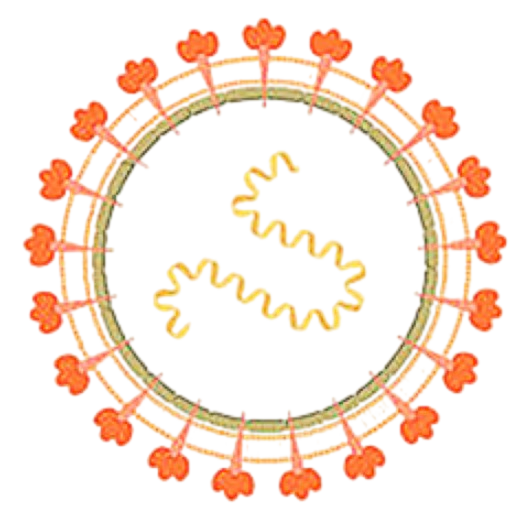
Figure 1
|
|
Functional Impact and Mechanisms
|
|
Disease
|
Chikungunya Fever
|
|
Immune
|
- |
|
Target Gene
|
-
|
|
Clinical and Epidemiological Correlations
|
|
Clinical Information
|
- |
|
Treatment
|
- |
|
Location
|
- |
|
Literature Information
|
|
PMID
|
28480053
|
|
Title
|
Understanding the evolution and spread of chikungunya virus in the Americas using complete genome sequences
|
|
Author
|
Sahadeo NSD,Allicock OM,De Salazar PM,Auguste AJ,Widen S,Olowokure B,Gutierrez C,Valadere AM,Polson-Edwards K,Weaver SC,Carrington CVF
|
|
Journal
|
Virus evolution
|
|
Journal Info
|
2017 May 3;3(1):vex010
|
|
Abstract
|
Local transmission of chikungunya virus (CHIKV) was first detected in the Americas in December 2013, after which it spread rapidly throughout the Caribbean islands and American mainland, causing a major chikungunya fever epidemic. Previous phylogenetic analysis of CHIKV from a limited number of countries in the Americas suggests that an Asian genotype strain was responsible, except in Brazil where both Asian and East/Central/South African (ECSA) lineage strains were detected. In this study, we sequenced thirty-three complete CHIKV genomes from viruses isolated in 2014 from fourteen Caribbean islands, the Bahamas and two mainland countries in the Americas. Phylogenetic analyses confirmed that they all belonged to the Asian genotype and clustered together with other Caribbean and mainland sequences isolated during the American outbreak, forming an 'Asian/American' lineage defined by two amino acid substitutions, E2 V368A and 6K L20M, and divided into two well-supported clades. This lineage is estimated to be evolving at a mean rate of 5 x 10(-4) substitutions per site per year (95% higher probability density, 2.9-7.9 x 10(-4)) and to have arisen from an ancestor introduced to the Caribbean (most likely from Oceania) in about March 2013, 9 months prior to the first report of CHIKV in the Americas. Estimation of evolutionary rates for individual gene regions and selection analyses indicate that (in contrast to the Indian Ocean Lineage that emerged from the ECSA genotype followed by adaptive evolution and with a significantly higher substitution rate) the evolutionary dynamics of the Asian/American lineage are very similar to the rest of the Asian genotype and natural selection does not appear to have played a major role in its emergence. However, several codon sites with evidence of positive selection were identified within the non-structural regions of Asian genotype sequences outside of the Asian/American lineage.
|
|
Sequence Data
|
-
|
|
|